Introduction
Uptime monitoring tells you when your website stops responding. Downtime costs visitors, revenue and search rankings.
Uptime.com is a well-known service for this. Some alternatives have a free plan, check more often on their listed plans, or include status pages that Uptime.com sells as an add-on. Uptimia is one of them.
Uptime monitoring features to look for
- Real-time Alerts: A notification the moment your website goes down.
- Detailed Reporting: Uptime and performance trends over time.
- Global Monitoring Locations: Checks from several regions show whether distant visitors can reach the site and how fast it loads for them.
- Single Dashboard: All monitoring data on one screen.
- Integration Capabilities: Alerts sent to the tools your team already uses, such as incident management systems.
- Customizable Alerting Options: Rules for who gets alerted and how: SMS, email or phone call.
- Uptime Guarantee Tracking: Compares the uptime your hosting provider promises with the uptime your site actually got.
- Automated Downtime Diagnostics: Records the likely cause of an outage as it happens.
- Public Status Pages: A page where users can check your site's status and read incident updates.
- SSL Certificate Monitoring: Warns you when a certificate is about to expire, becomes invalid or may have been compromised.
Best Alternatives to Uptime.com in 2026
Uptimia wrote this page, and Uptimia is our product, so it is listed first. The other tools are not ranked: their order is not a verdict on which is better. The evidence section at the bottom gives the source and check date for each competitor figure we cite.
1. Uptimia
uptimia.com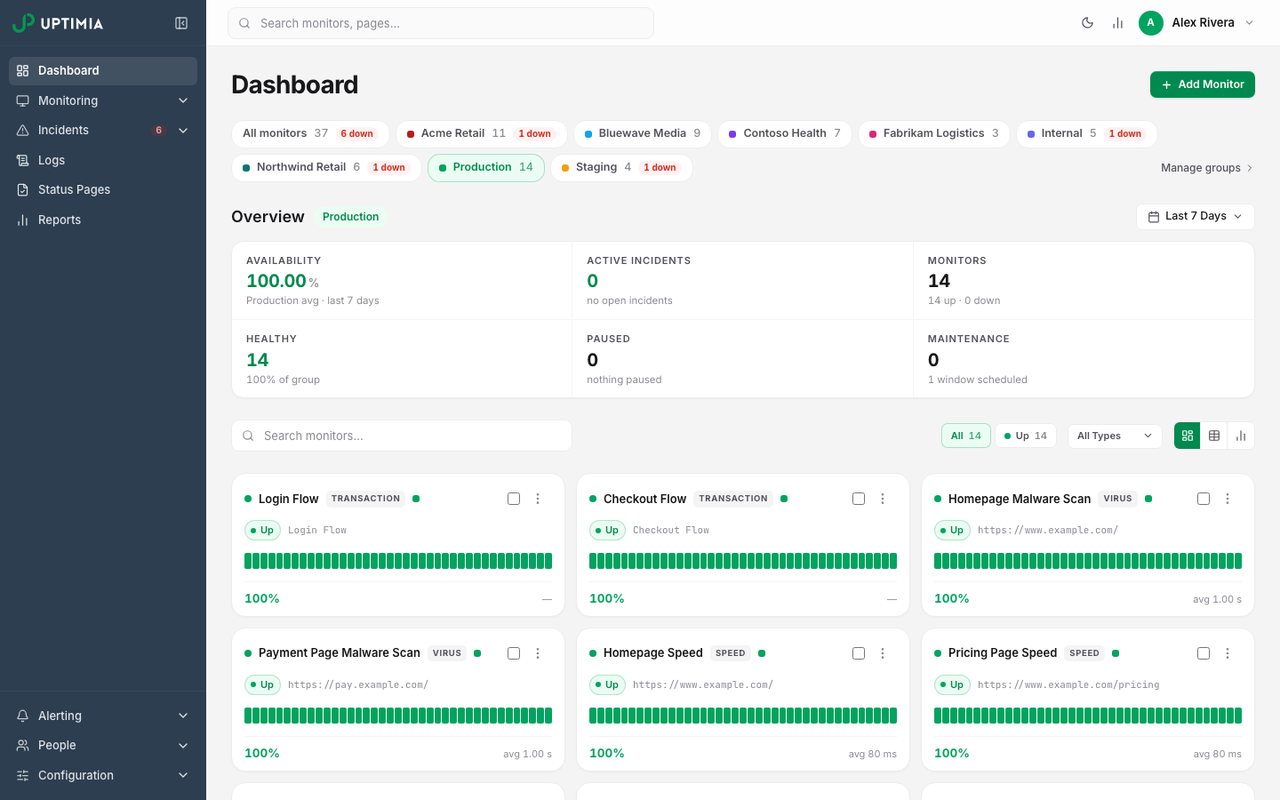
- What it is
- Website, transaction, page-speed, real-user and server monitoring in one plan, with data stored in the EU.
- Check types
- Website (HTTP), Keyword, Ping, Port, UDP, Cron jobs (heartbeat), API, Multi-step API, DNS, SSL certificate, Domain expiry, Browser transactions, Page speed, Real user monitoring, Server agent, Blacklist, Malware, Status pages
- Free plan
- 1 monitor, checks every 5 minutes
- Paid plans from
- $9 a month, billed yearly
- Fastest check
- 30 seconds
Uptimia puts uptime, speed, SSL, transaction and other checks in one account.
Main Features:
- Uptime monitoring over HTTP, HTTPS, Ping, Keyword, TCP, UDP, DNS, SMTP, POP3 and IMAP.
- Speed monitoring of page load time.
- SSL certificate health and expiration and domain expiration monitoring.
- Multiple-step transaction monitoring for flows such as a checkout.
- Real user monitoring of what actual visitors experience.
- Public status pages.
- Virus monitoring that detects malware on a hacked website.
- API monitoring that checks each response in a chain of HTTP requests, and heartbeat monitoring for cron jobs.
- DNS, blacklist (for sending domains) and server monitoring.
- Alerts by email and text message, and in WhatsApp, Discord, Telegram and Slack.
Best Suited For:
Websites of any size that need 24x7 monitoring.
Why is Uptimia better than Uptime.com?
- Pricing at 100 monitors: Uptimia Professional costs $45 a month, or $39 a month billed yearly, for 100 monitors. Uptime.com's 100-check tier costs $75 a month, or $60 a month billed yearly.
- Status pages and real user monitoring included: Professional includes 10 status pages and real user monitoring. Uptime.com sells both as paid add-ons.
- API and heartbeat checks outside the advanced pool: Uptime.com counts API, transaction, page speed and heartbeat checks against one allowance of advanced checks (10 on the 100-check tier). Professional has 10 advanced checks shared by page speed and browser transactions, plus 10 API monitors and 100 heartbeat monitors on top.
- Check frequency: Uptimia checks every 30 seconds from Professional up. Uptime.com's own pages disagree on its fastest check: as low as 30 seconds (website-monitoring page; the pricing page lists 1 minute).
- Free plan: Uptimia has a free plan with 1 monitor checked every 5 minutes. Uptime.com has no free plan, only a 30-day money-back guarantee.
- More text alerts: Professional includes 150 text alerts a month. Uptime.com's 100-check tier includes 100 a month.
How is Uptimia worse than Uptime.com?
- Uptime.com is the older brand, running since 2013.
- Uptime.com costs less for small accounts: 10 checks cost $9 a month, or $7 a month billed yearly, against $10 or $9 for Uptimia Basic.
- Every Uptime.com tier has unlimited users. Uptimia Basic allows the account owner plus one team member, and Professional the owner plus 10 team members.
- Uptime.com offers single sign-on (SSO) on all plans and keeps 24 months of check history. Uptimia has no SSO and keeps 12 months of history on Professional.
2. Site24x7
site24x7.com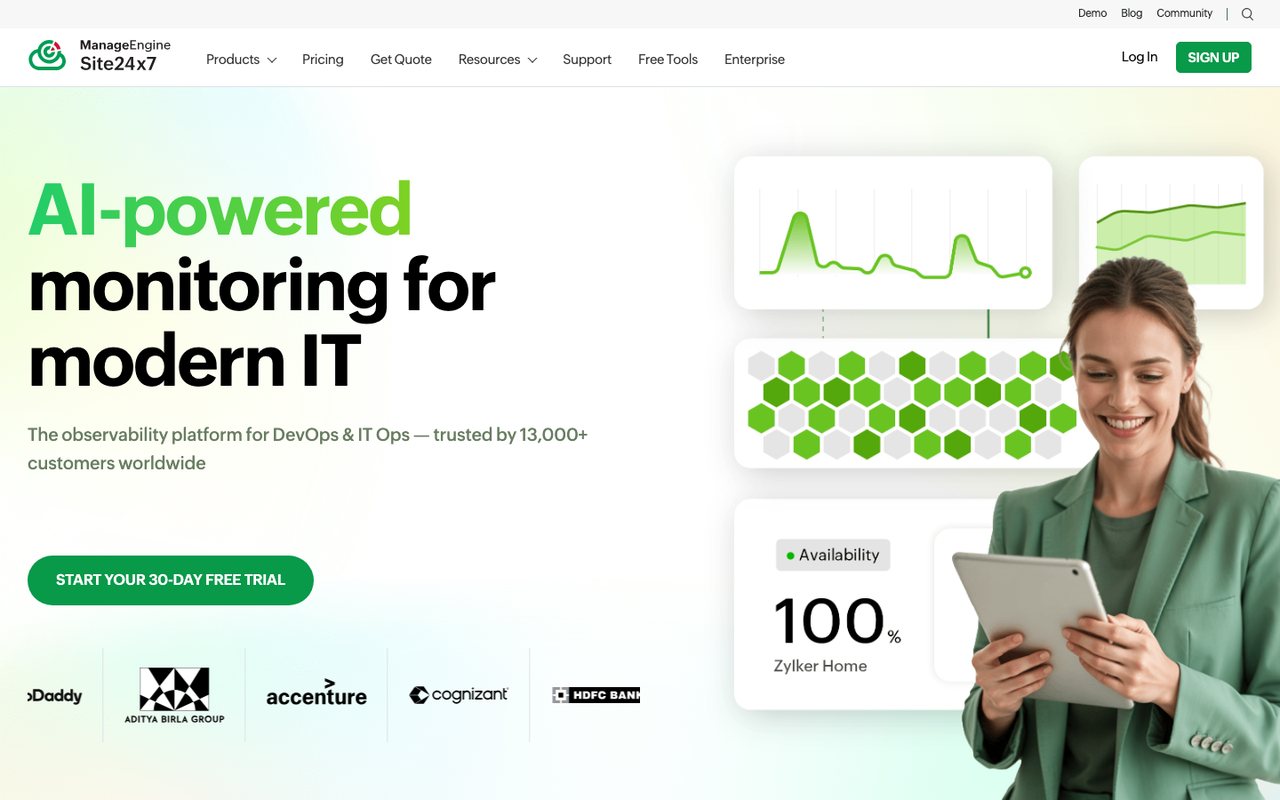
- What it is
- Website, synthetic, real-user, server, cloud and network monitoring from Zoho's ManageEngine division, with hosted status pages.
- Check types
- Website (HTTP), Keyword, Ping, Port, UDP, Cron jobs (heartbeat), API, Multi-step API, DNS, SSL certificate, Domain expiry, Browser transactions, Page speed, Real user monitoring, Server agent, Blacklist, Malware, Status pages, Logs, APM / tracing, Network devices
- Free plan
- 50 monitors (another Site24x7 page says 5)
- Paid plans from
- $9 a month, billed yearly
- Fastest check
- 10 seconds
- Prices checked
- 8–12 Oct 2026
Site24x7 monitors websites, applications, servers and networks.
Main features:
- Application Performance Management: Shows where applications slow down.
- Server and Cloud Monitoring: Flags health problems on servers and cloud resources.
- Log Analysis: Built-in log management.
- User Experience Monitoring: Records how real users interact with the site.
Best suited for:
Medium and large organizations that want application, server and network data in one system.
Why is Site24x7 better than Uptime.com?
- It also monitors servers, applications (APM), logs and networks. Uptime.com's pricing page lists no server agent, APM or log product.
- It checks from 130+ locations. Uptime.com includes 12 check locations and sells more as a paid add-on.
- It has a free plan (50 monitors on Site24x7's pricing page; another Site24x7 page says 5). Uptime.com has no free plan.
How is Site24x7 worse than Uptime.com?
- Its entry Web Uptime plan sends alerts by email only, according to the plan table on Site24x7's pricing page (its free-plan page also lists SMS).
- Web Uptime has no API access, and the plan table lists multi-user support as not available below Enterprise Plus Web (another row of the same table allows up to 10 users on Web Uptime). Every Uptime.com tier has unlimited users.
- Transaction monitoring and real user monitoring are not part of Web Uptime.
3. StatusCake
statuscake.com
- What it is
- External monitoring for websites, APIs, SSL certificates, domains, page speed and servers, with status pages sold as a separate product.
- Check types
- Website (HTTP), Keyword, Ping, Port, Cron jobs (heartbeat), DNS, SSL certificate, Domain expiry, Page speed, Server agent, Blacklist
- Free plan
- 10 monitors, checks every 5 minutes
- Paid plans from
- €16.66 a month, billed yearly
- Fastest check
- 30 seconds
- Prices checked
- 8–12 Oct 2026
StatusCake covers uptime, page speed, domains, SSL certificates and server health.
Main features:
- Uptime Monitoring: Check intervals from 5 minutes on the free plan down to 30 seconds on Business, and a constant check rate on Enterprise.
- Page Speed Tracking: Load-time reports that show where a page is slow.
- Domain Monitoring: Watches domain records and alerts you before a domain expires.
- Server Health Checks: Alerts on unusual server status.
- SSL Monitoring: Renewal alerts and certificate setup checks.
Best suited for:
Anyone from a single site owner to an enterprise.
Why is StatusCake better than Uptime.com?
- Its Business plan checks every 30 seconds. Uptime.com's price list stops at 1-minute checks.
- It has a free plan with 10 monitors. Uptime.com has no free plan.
- It includes server monitoring through an agent. Uptime.com's pricing page lists no server agent.
How is StatusCake worse than Uptime.com?
- Its check list has no multi-step API checks and no real user monitoring. Uptime.com has both, with real user monitoring as an add-on.
- It has no browser transaction checks: its login tests post form data to a URL instead of running a browser through the steps. Every Uptime.com tier includes transaction monitoring.
- It tests from 43 locations, fewer than Uptime.com reaches with its paid location add-on.
4. Pingdom
pingdom.com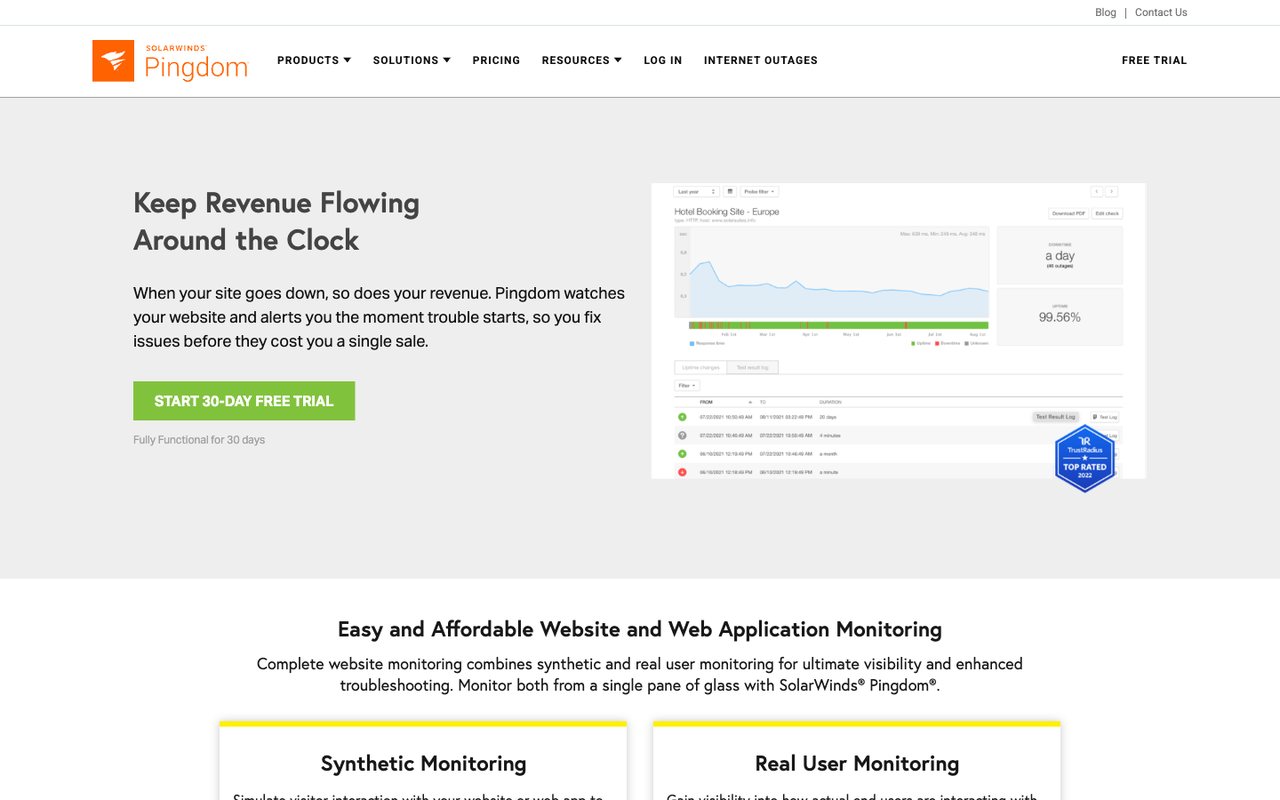
- What it is
- SolarWinds' website monitoring service, with uptime, page speed and browser transaction checks plus real-user monitoring sold separately.
- Check types
- Website (HTTP), Keyword, Ping, Port, UDP, DNS, SSL certificate, Browser transactions, Page speed, Real user monitoring, Status pages
- Free plan
- None
- Paid plans from
- $16.50 a month, billed yearly
- Fastest check
- 1 minute
- Prices checked
- 8–12 Oct 2026
Pingdom monitors site speed and user experience.
Main features:
- Synthetic Monitoring: Simulates visitor actions to test the site from the outside.
- Real User Monitoring: Uses data from actual visitors to find what slows the site down.
Best suited for:
Developers and webmasters who care most about site speed and user experience.
Why is Pingdom better than Uptime.com?
- A public status page comes with every plan. Uptime.com sells status pages as an add-on from $13 a month.
- It has a 30-day free trial of Synthetics and RUM. Uptime.com has no trial, only a 30-day money-back guarantee.
- Its owner, SolarWinds, sells infrastructure and application monitoring (AppOptics) and log management (Loggly) as separate products, if you want them from one vendor.
How is Pingdom worse than Uptime.com?
- Its check list has no multi-step API checks and no heartbeat (cron) checks. Uptime.com has both.
- Pingdom retired its iOS and Android apps. Uptime.com has both.
- SolarWinds is moving Pingdom accounts to SolarWinds Observability, and check history is not carried over.
5. Uptrends
uptrends.com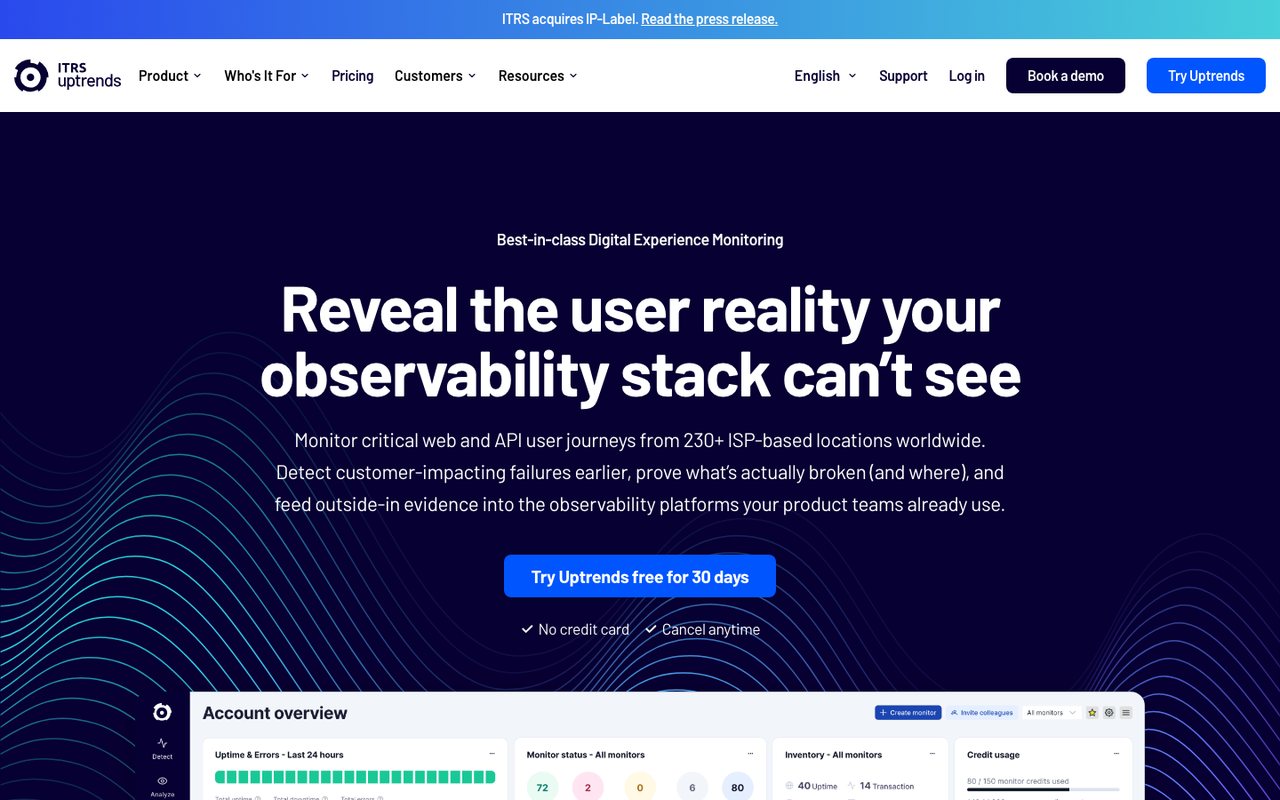
- What it is
- Synthetic monitoring for websites, APIs and multi-step browser transactions, with real-user monitoring as an add-on and public status pages.
- Check types
- Website (HTTP), Keyword, Ping, Port, DNS, SSL certificate, API, Multi-step API, Browser transactions, Page speed, Real user monitoring, Status pages
- Free plan
- None
- Paid plans from
- $42 a month, billed yearly
- Fastest check
- 30 seconds
- Prices checked
- 8–12 Oct 2026
Uptrends covers synthetic, API, real user and infrastructure monitoring.
Main features:
- Synthetic & API Monitoring: Tests website functions and API performance from locations around the world.
- Real User Monitoring: Measures speed as real users experience it.
- Infrastructure Monitoring: Uptrends Infra, a separate product, monitors servers and network devices through an agent for Windows and Linux.
- Performance Tools: Waterfall charts and filmstrips (Pro) and error snapshots show what slows a page down.
- Integrations: Connects to other tools and comes with free performance testing tools.
Best suited for:
Larger companies with many websites, applications and APIs to watch.
Why is Uptrends better than Uptime.com?
- It checks from 230+ checkpoints. Uptime.com includes 12 check locations and sells more as a paid add-on.
- Its support team can write and test transaction scripts from your recordings (the full-service option).
How is Uptrends worse than Uptime.com?
- It costs more to start: Core starts from $46 a month ($42 billed yearly), against $9 for Uptime.com's smallest tier.
- Core checks every 2 minutes and has no transaction or API monitors; those start on Pro. Every Uptime.com tier includes transaction and API monitoring.
- Uptime.com lists private location monitoring on its pricing page; at Uptrends, private synthetic checkpoints need the Enterprise plan. Its separate Infra product monitors servers and network devices from inside the firewall.
6. Dotcom-Monitor
dotcom-monitor.com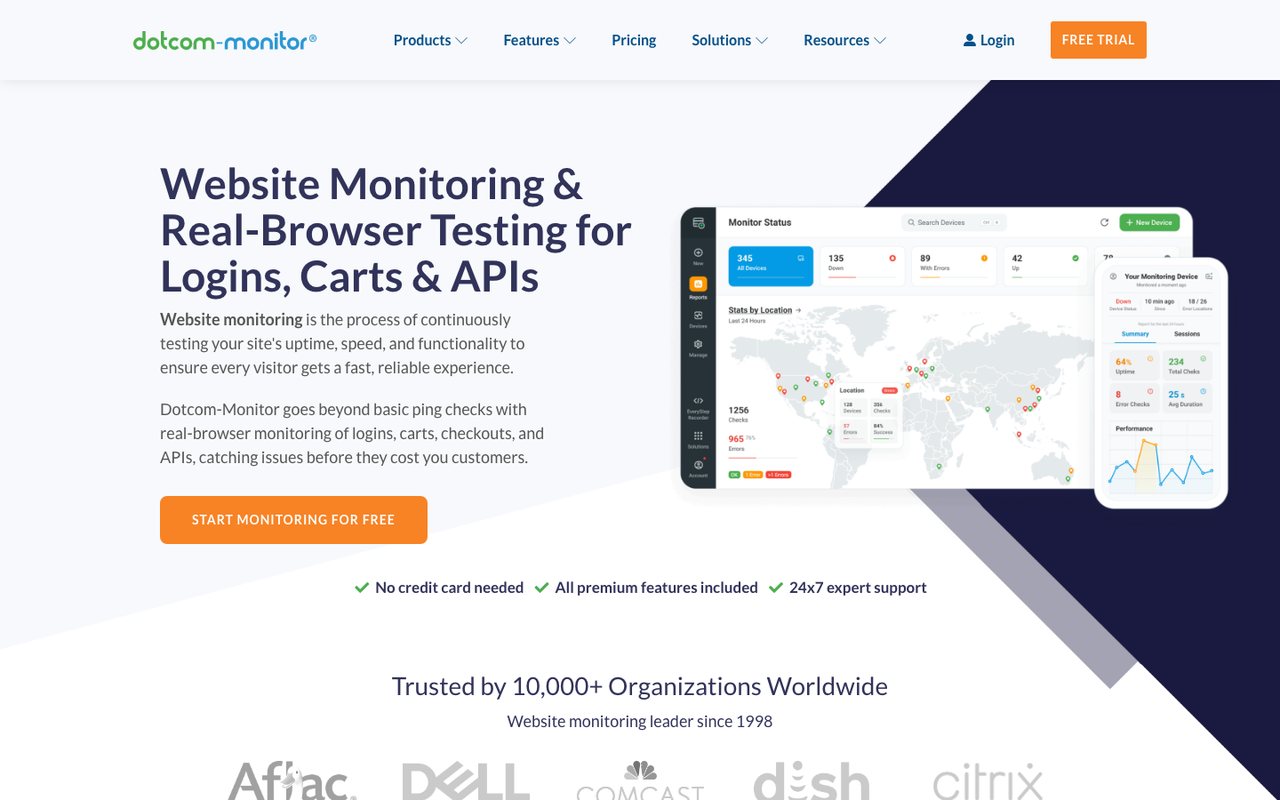
- What it is
- Synthetic monitoring for websites, APIs, multi-step web transactions and network protocols, priced per platform by number of targets and check frequency.
- Check types
- Website (HTTP), Keyword, Ping, Port, UDP, Cron jobs (heartbeat), API, Multi-step API, DNS, SSL certificate, Browser transactions, Page speed, Server agent, Blacklist, Network devices
- Free plan
- 25 monitors, checks every 5 minutes
- Fastest check
- 1 minute
- Prices checked
- 8–12 Oct 2026
Dotcom-Monitor monitors web applications, web services, pages and infrastructure, and also runs load tests.
Main features:
- Web Application Monitoring: Alerts, data history and performance thresholds, tested in a wide range of browsers.
- Web Service Monitoring: Status, performance checks and alerts for APIs, SSL and WebSocket connections.
- Web Page Monitoring: Real-browser checks in several browsers, with page load details.
- Infrastructure Monitoring: Networks and servers, with custom alerts.
- Load & Stress Testing: Simulates users to show how much load the system can take.
- Application Performance Monitoring: Performance data covering interactions, transactions and load.
Best suited for:
Businesses whose applications must work the same in every browser.
Why is Dotcom-Monitor better than Uptime.com?
- It records video of browser errors.
- It includes load and stress testing, which Uptime.com's pricing page does not list.
- It has a forever-free plan for up to 25 targets. Uptime.com has no free plan.
How is Dotcom-Monitor worse than Uptime.com?
- It costs more to start paying: Uptime.com's smallest tier costs $9 a month, against $13.33 for Dotcom-Monitor's cheapest paid package.
- Each platform (web pages, APIs, browser transactions, servers) is a separate package priced by targets and check frequency, and yearly prices are not published. Uptime.com covers all its check types in one tier and publishes yearly prices.
7. Cronitor
cronitor.io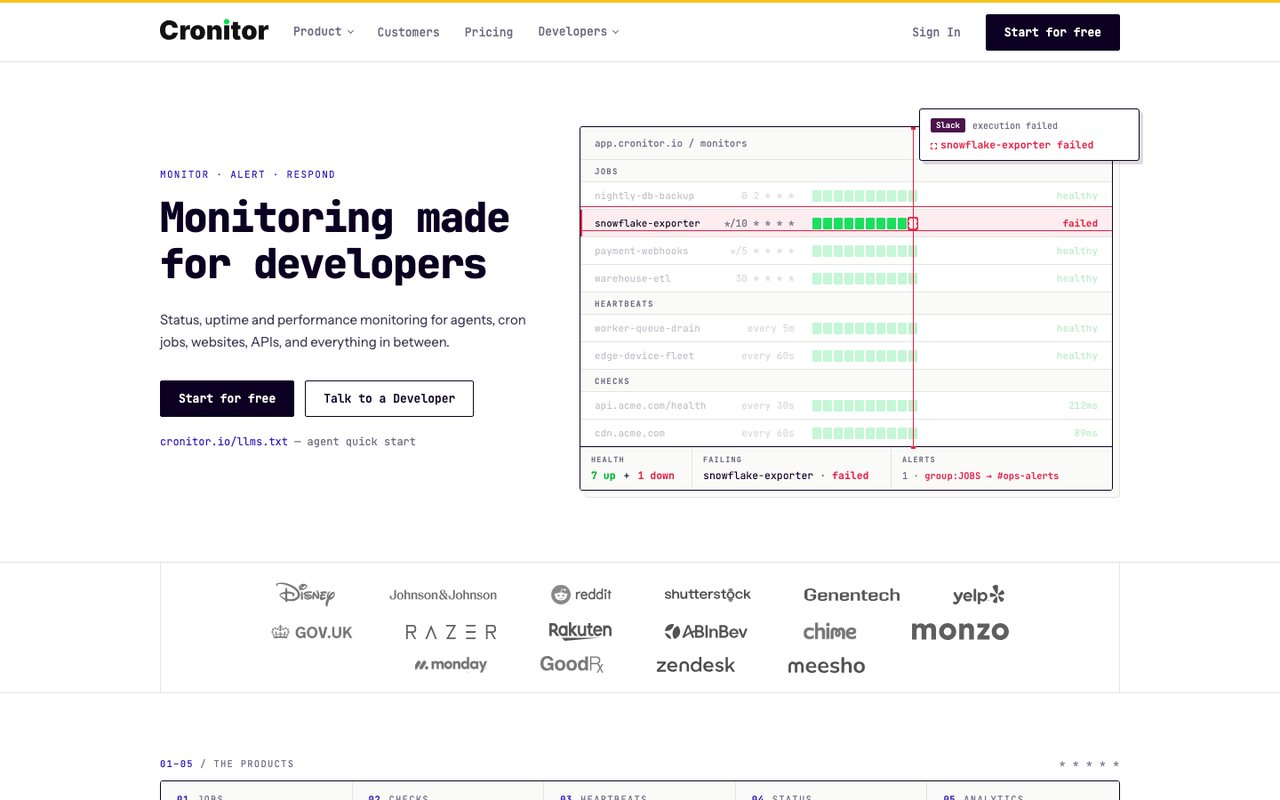
- What it is
- Monitoring for cron jobs, background workers, heartbeats, websites and APIs, with real-user monitoring and status pages.
- Check types
- Website (HTTP), Keyword, API, Port, UDP, Cron jobs (heartbeat), SSL certificate, Real user monitoring, Status pages
- Free plan
- 5 monitors, checks every 5 minutes
- Fastest check
- 30 seconds
- Prices checked
- 8–12 Oct 2026
Cronitor monitors cron jobs, websites, APIs, servers and real user experience.
Main features:
- Cron Job Monitoring: Captures job output, detects slow jobs and tracks run times.
- Uptime Monitoring: Checks websites, APIs and servers, with alerts designed to avoid false alarms.
- Heartbeat Monitoring: Tracks hosts, email campaigns and other system components.
- Status Pages: Incident announcements and scheduled maintenance.
- Real User Monitoring (RUM): Website traffic, experience data and performance alerts.
Best suited for:
Developers with many scheduled tasks to watch.
Why is Cronitor better than Uptime.com?
- A free Hacker plan covers 5 monitors, and the Business plan costs $2 a month per monitor plus $5 a month per user.
- Business checks every 30 seconds. Uptime.com's price list stops at 1-minute checks.
How is Cronitor worse than Uptime.com?
- Its check types do not include ping, DNS, blacklist or malware checks. Uptime.com has all four.
- PagerDuty, Opsgenie and the other on-call integrations need a paid Cronitor plan. Uptime.com includes its integrations in every tier.
8. Better Stack
betterstack.com/uptime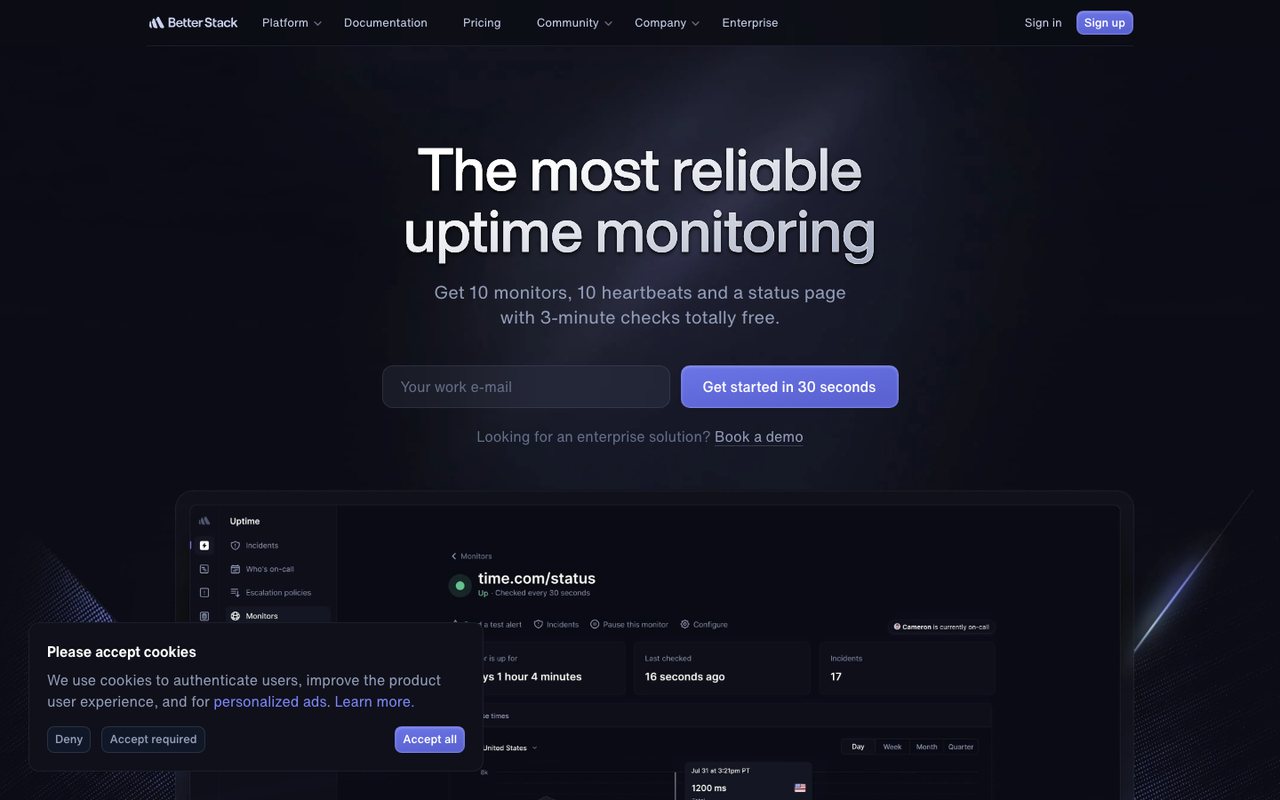
- What it is
- An observability platform that bundles uptime and cron monitoring, on-call and incident management, status pages, logs, metrics, tracing, error tracking and real-user monitoring.
- Check types
- Website (HTTP), Keyword, Ping, Port, UDP, Cron jobs (heartbeat), API, DNS, SSL certificate, Domain expiry, Browser transactions, Real user monitoring, Server agent, Status pages, Logs, APM / tracing
- Free plan
- 10 monitors, checks every 3 minutes
- Paid plans from
- $29 a month, billed yearly
- Fastest check
- 30 seconds
- Prices checked
- 12 Oct 2026
Better Stack Uptime sends downtime alerts and tests user flows such as login, sign-up and checkout with Playwright. Each incident report includes screenshots and error logs.
Main features:
- Incident Verification: A failure is confirmed in several steps and from several locations before an alert goes out.
- Playwright Tests: Scripted browser tests of user journeys.
- Incident Management: On-call calendar with calendar sync, escalations and an audit timeline for each incident.
- Logs and Dashboards: Log queries, including SQL, and ready-made dashboards for many services.
Best suited for:
Development teams that want monitoring, on-call escalations and logs in one tool.
Why is Better Stack better than Uptime.com?
- It checks every 30 seconds on a paid Responder licence. Uptime.com's price list stops at 1-minute checks.
- Each Responder licence includes unlimited phone-call and text alerts. Uptime.com's tiers have a monthly allowance (25 on the smallest).
- It has a free plan with 10 monitors and one status page. Uptime.com has no free plan and sells status pages as an add-on.
- It includes log management and on-call scheduling. Uptime.com's pricing page lists no log product.
How is Better Stack worse than Uptime.com?
- Paid use starts at $34 a month ($29 billed yearly) for one responder, against $9 for Uptime.com's smallest tier.
- It has no blacklist or malware checks, which Uptime.com includes.
9. Hyperping
hyperping.com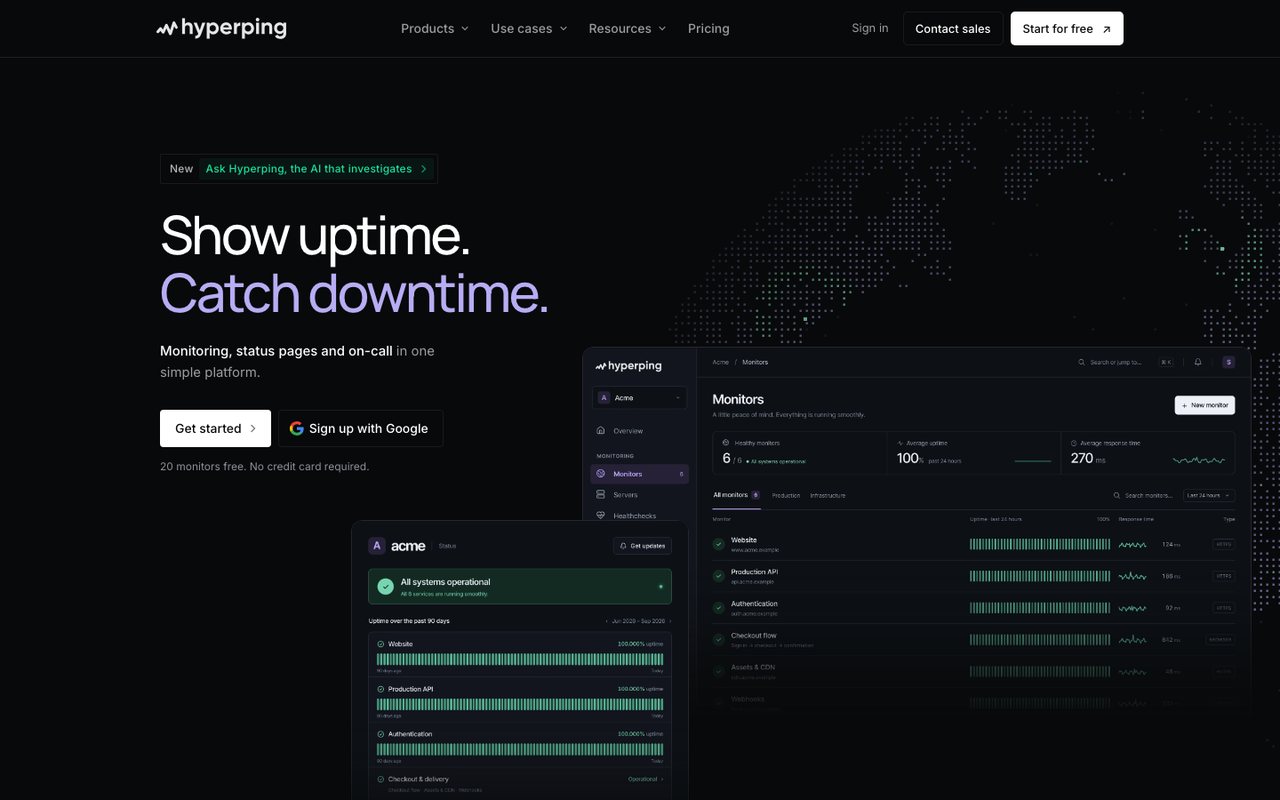
- What it is
- Uptime, cron, SSL and browser-check monitoring with status pages, on-call schedules and escalation in one product, run from France.
- Check types
- Website (HTTP), Keyword, Ping, Port, Cron jobs (heartbeat), API, DNS, SSL certificate, Domain expiry, Browser transactions, Server agent, Status pages, Logs
- Free plan
- 20 monitors, checks every 5 minutes
- Paid plans from
- $24.17 a month, billed yearly
- Fastest check
- 20 seconds
- Prices checked
- 8–12 Oct 2026
Hyperping combines synthetic monitoring with status pages for keeping users informed during outages.
Main features:
- Status Pages: Custom pages for service updates and scheduled maintenance, in light and dark modes.
- Synthetic Monitoring: Checks in a real Chrome browser, scripted with Playwright, from locations around the world.
- Cron Job Monitoring: Tracks when cron jobs run, with adjustable grace periods.
- Team and Enterprise Features: 30-second checks, SSL monitoring, end-to-end tests and integrations. SAML SSO comes with Pro and API access with every paid plan; the custom-quote Enterprise tier adds a custom contract, white-glove migration and dedicated support.
Best suited for:
Small and medium businesses that want low-cost monitoring and a direct way to update customers during an outage.
Why is Hyperping better than Uptime.com?
- It has a free plan with 20 monitors. Uptime.com has no free plan.
- Status pages come with every plan, from 1 on the free plan to 10 on Business. Uptime.com sells them as an add-on.
- It checks every 30 seconds from the Essentials plan up. Uptime.com's price list stops at 1-minute checks.
- It stores its primary customer data in the EU, in Frankfurt. Uptime.com hosts on Amazon Web Services in the United States and globally.
How is Hyperping worse than Uptime.com?
- Real user monitoring, page speed monitoring, blacklist or malware checks and multi-step API checks are not listed on Hyperping's pricing page. Uptime.com has all of them.
10. OneUptime
oneuptime.com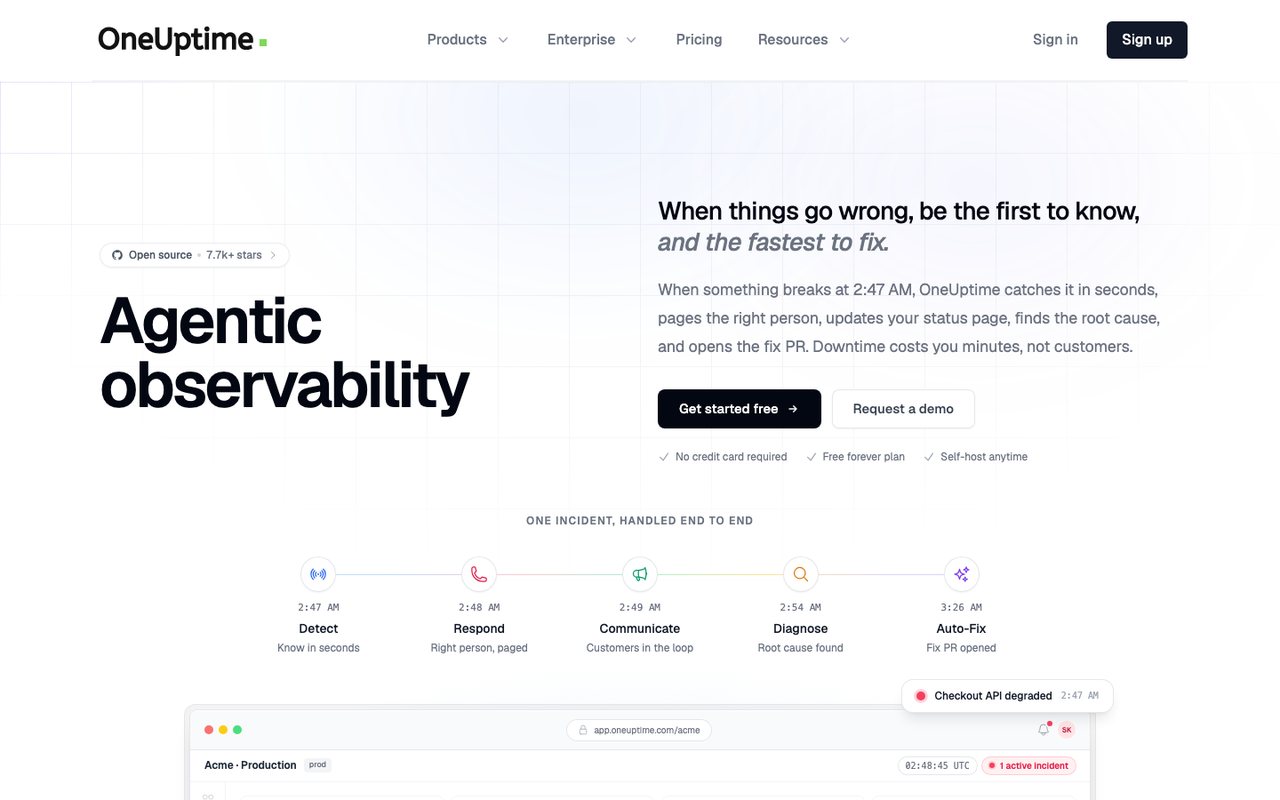
- What it is
- An open-source observability platform that bundles uptime and synthetic monitoring, status pages, incident management, on-call alerting, logs, metrics, traces and real-user monitoring, sold as SaaS or self-hosted.
- Check types
- Website (HTTP), Keyword, Ping, Port, Cron jobs (heartbeat), API, DNS, SSL certificate, Domain expiry, Browser transactions, Real user monitoring, Server agent, Third-party dependencies, Status pages, Logs, APM / tracing, Network devices
- Free plan
- $0 plan, active monitors $1 each a month
- Paid plans from
- $20 per user a month, billed yearly, plus $1 per active monitor
- Fastest check
- 1 minute
- Prices checked
- 8–12 Oct 2026
OneUptime combines monitoring, incident management, status pages, logs and APM.
Main features:
- Status Pages: Unlimited public and private status pages.
- Incident Management: Custom severities and post-incident reports.
- Monitoring: Checks websites, APIs and other online services, with flexible alert rules.
- On-Call & Alerts: Alerts through many channels, including team chat tools.
- Logs Management and APM: Collects logs from many sources and adds application performance monitoring.
- Enterprise: Every feature without limits, tailored support and strict security compliance.
Best suited for:
Businesses that want monitoring and incident handling together, especially with specific compliance or support requirements.
Why is OneUptime better than Uptime.com?
- It has a free plan with a status page and unlimited manual monitors; active monitors cost $1 each a month. Uptime.com has no free plan and sells status pages as an add-on.
- It includes logs, metrics, traces and APM. Uptime.com's pricing page lists none of these.
- The community edition is open source (Apache 2.0) and can be self-hosted for free.
How is OneUptime worse than Uptime.com?
- Paid plans are priced per user ($20 a month per user on Growth, billed yearly), on top of active monitors. Every Uptime.com tier has unlimited users.
- Text alerts and phone calls are billed per message or minute ($0.10 per SMS). Uptime.com's tiers include a monthly allowance.
11. RapidSpike
rapidspike.com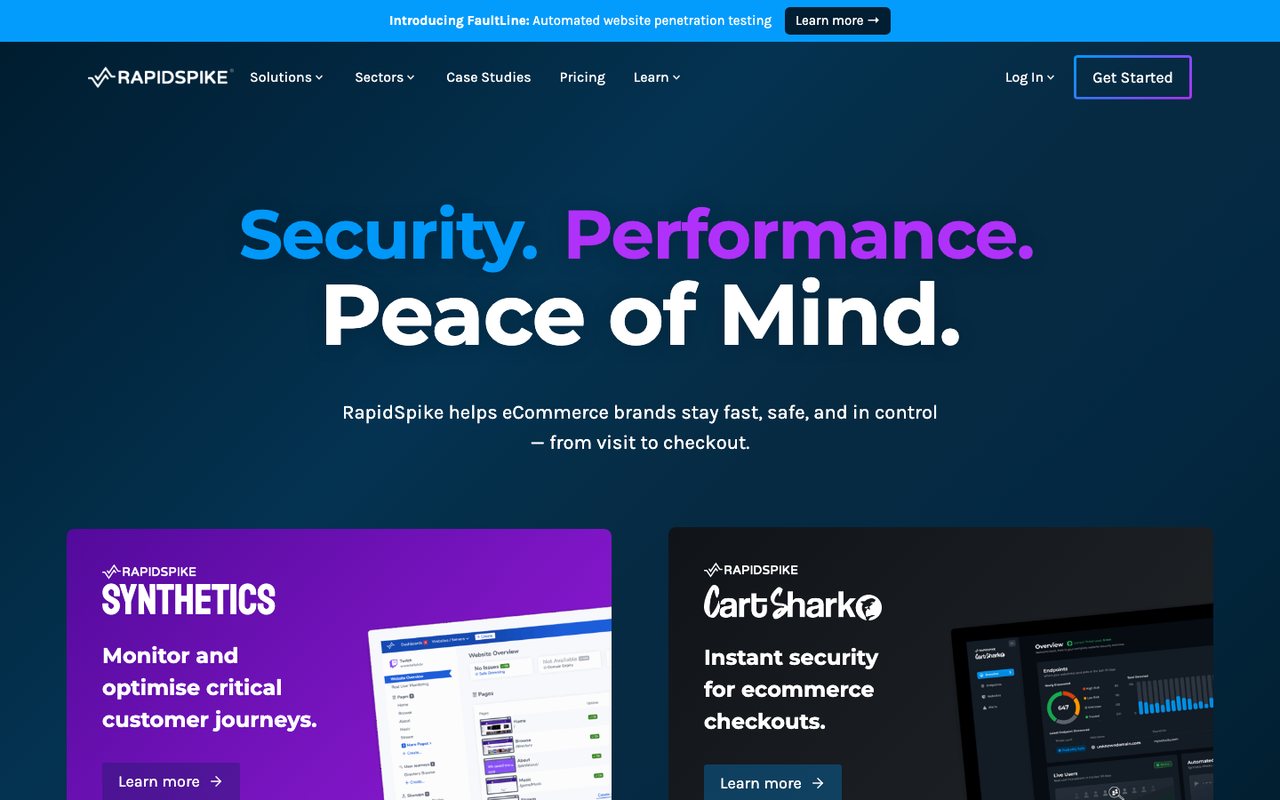
- What it is
- Synthetic user-journey, page-load, uptime and Magecart monitoring aimed at ecommerce and travel sites, sold after a demo; listed prices are billed annually, with monthly billing on request.
- Check types
- Website (HTTP), Keyword, Ping, Port, API, SSL certificate, Domain expiry, Browser transactions, Page speed, Real user monitoring, Status pages
- Free plan
- None
- Prices checked
- 8–12 Oct 2026
RapidSpike monitors website performance, security and reliability.
Main features:
- Performance Monitoring: User experience metrics, page tests and continuous performance audits.
- Security Monitoring: Scans for common attack patterns to find web skimming threats.
- Journey Monitoring: Watches the customer journey 24/7, with custom alerts for broken journeys, slow load times, errors and issues that hurt the website or its search rankings.
- Web Vitals: Tracks Core Web Vitals and the impact of third-party services.
Best suited for:
E-commerce sites that put security and customer journeys first.
Why is RapidSpike better than Uptime.com?
- It offers dedicated protection against Magecart attacks.
- It finds client-side vulnerabilities in the visitor's browser.
How is RapidSpike worse than Uptime.com?
- It costs more to start: Synthetics plans start from £199 a month billed annually.
- Its published check list does not include the DNS checks that Uptime.com offers.
- Text and voice alerts need paid Alert Credit bundles on top of the plan. Every Uptime.com tier includes a monthly allowance.
12. Super Monitoring
supermonitoring.com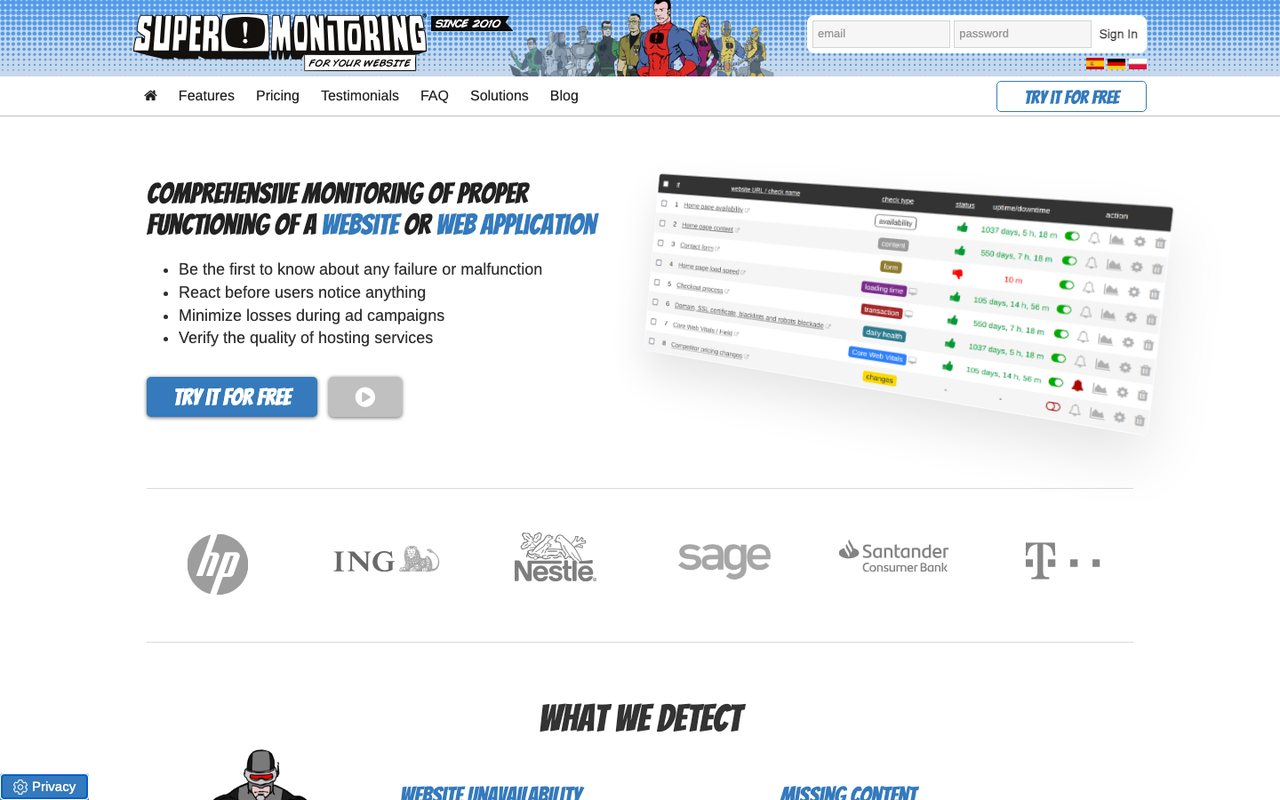
- What it is
- Website monitoring from a Polish company that checks uptime, page content, forms, load time, checkout flows, domain and SSL expiry, blacklists and Core Web Vitals.
- Check types
- Website (HTTP), Keyword, Ping, Port, SSL certificate, Domain expiry, Browser transactions, Page speed, Blacklist, Status pages
- Free plan
- None
- Paid plans from
- $4.92 a month, billed yearly
- Fastest check
- 1 minute
- Prices checked
- 8–12 Oct 2026
Super Monitoring checks websites and many types of server and measures performance.
Main features:
- Server Monitoring: FTP, SMTP, IMAP, database and other server types.
- Content and Integrity Checks: Verifies page content and watches for file changes.
- Performance: Page load times and error reports.
- Alerts: Email, SMS and other channels.
- Form and Process Checks: Tests that web forms and multi-step processes still work.
Best suited for:
Small and medium businesses that want low-cost monitoring with wide server coverage.
Why is Super Monitoring better than Uptime.com?
- Unlimited status pages are included, in four languages. Uptime.com sells status pages as an add-on.
- Alerts go to unlimited recipients.
- It has plugins for WordPress, Drupal, Joomla, Magento and PrestaShop.
How is Super Monitoring worse than Uptime.com?
- It lacks some checks that Uptime.com has, such as heartbeat (cron job) checks and real user monitoring.
- It checks from 5 monitoring stations. Uptime.com includes 12 check locations.
13. 360 Monitoring
360monitoring.com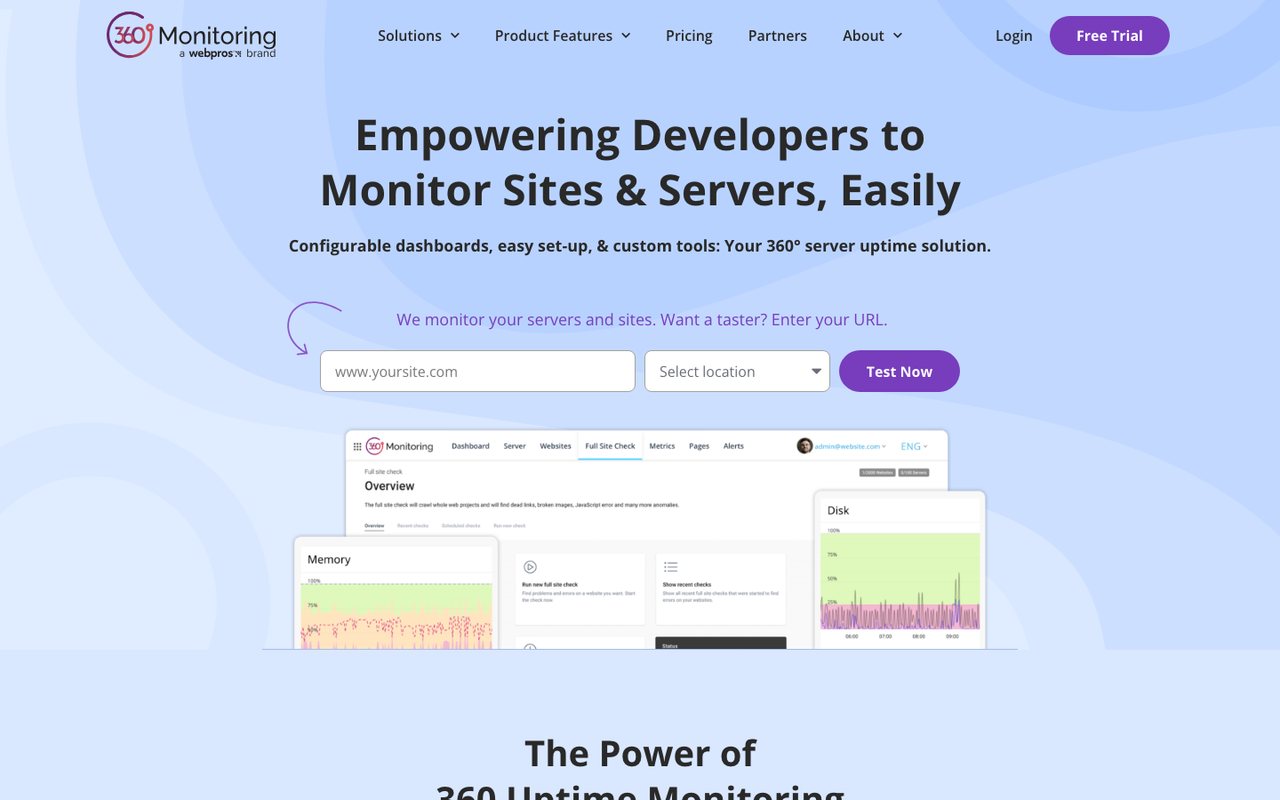
- What it is
- Website uptime and server monitoring from WebPros, with an open-source server agent, IP blocklist checks and a site crawler, built into the Plesk control panel.
- Check types
- Website (HTTP), Keyword, Ping, Port, SSL certificate, Server agent, Blacklist, Status pages
- Free plan
- 5 sites, 1 server, checks every 10 minutes
- Paid plans from
- $4.99 a month, billed monthly
- Fastest check
- 1 minute
- Prices checked
- 8–12 Oct 2026
360 Monitoring monitors websites and servers for web professionals and service providers.
Main features:
- Website Downtime Alerts: Tells you when your website goes down.
- Server Monitoring: CPU, memory, disk and other server metrics.
- Blocklist Monitoring: Checks spam blocklists to protect email deliverability and site reputation.
- Site Analysis: Crawls the whole site to find errors and broken links.
- Reporting: Historical performance data.
Best suited for:
Agencies, hosting providers and web professionals who want one low-cost tool.
Why is 360 Monitoring better than Uptime.com?
- It costs less: a free Lite plan covers 5 sites, and paid plans start at $4.99 a month.
- It includes server monitoring through an open-source agent. Uptime.com's pricing page lists no server agent.
- You can write custom plugins to monitor whatever you need.
How is 360 Monitoring worse than Uptime.com?
- Its check types do not include browser transactions, multi-step API checks or real user monitoring. Uptime.com has all three.
- Uptime.com can monitor internal networks, which 360 Monitoring does not say it can do.
- It is billed monthly only. Uptime.com gives a lower price for yearly billing.
14. Oh Dear
ohdear.app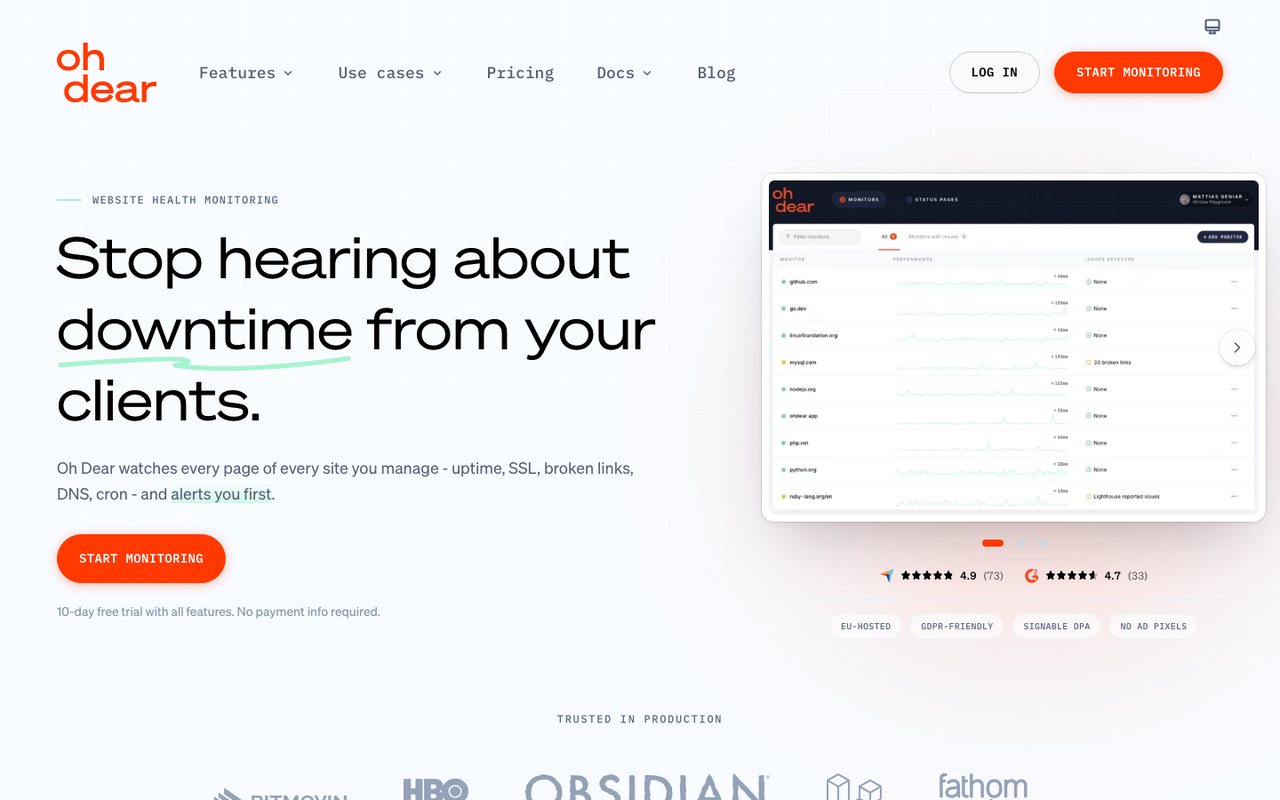
- What it is
- Website monitoring priced per site, bundling uptime, SSL, broken links, performance, DNS, cron checks and status pages on every plan, run from Belgium.
- Check types
- Website (HTTP), Keyword, Ping, Port, Cron jobs (heartbeat), API, DNS, SSL certificate, Domain expiry, Page speed, Blacklist, Status pages
- Free plan
- None
- Paid plans from
- $14.17 a month, billed yearly
- Fastest check
- 1 minute
- Prices checked
- 8–12 Oct 2026
Oh Dear tracks uptime and performance with a simple setup.
Main features:
- Uptime Monitoring: Instant alerts from locations around the world.
- Performance Monitoring: Reports and alerts against performance targets you set.
- Scheduled Task Monitoring: With custom notifications.
- Application Health Monitoring: Reports application problems as they happen.
- DNS, Domain and Certificate Monitoring: Alerts when DNS records change or break, checks that your domain stays secure, and catches SSL certificate problems.
Best suited for:
Website owners who want a simple setup.
Why is Oh Dear better than Uptime.com?
- Unlimited status pages with a custom domain come with every plan. Uptime.com sells status pages as an add-on.
- It includes Lighthouse checks of SEO, site health and performance, and finds broken pages and mixed content.
- Its primary data is stored in the EU, in Belgium. Uptime.com hosts on Amazon Web Services in the United States and globally.
How is Oh Dear worse than Uptime.com?
- It has no transaction monitoring or real user monitoring. Uptime.com has both.
- It costs more at the entry level: plans start at $17 a month ($14.17 billed yearly), against $9 for Uptime.com's smallest tier.
- Text alerts need your own Vonage account. Uptime.com's tiers include a monthly allowance.
15. UptimeRobot
uptimerobot.com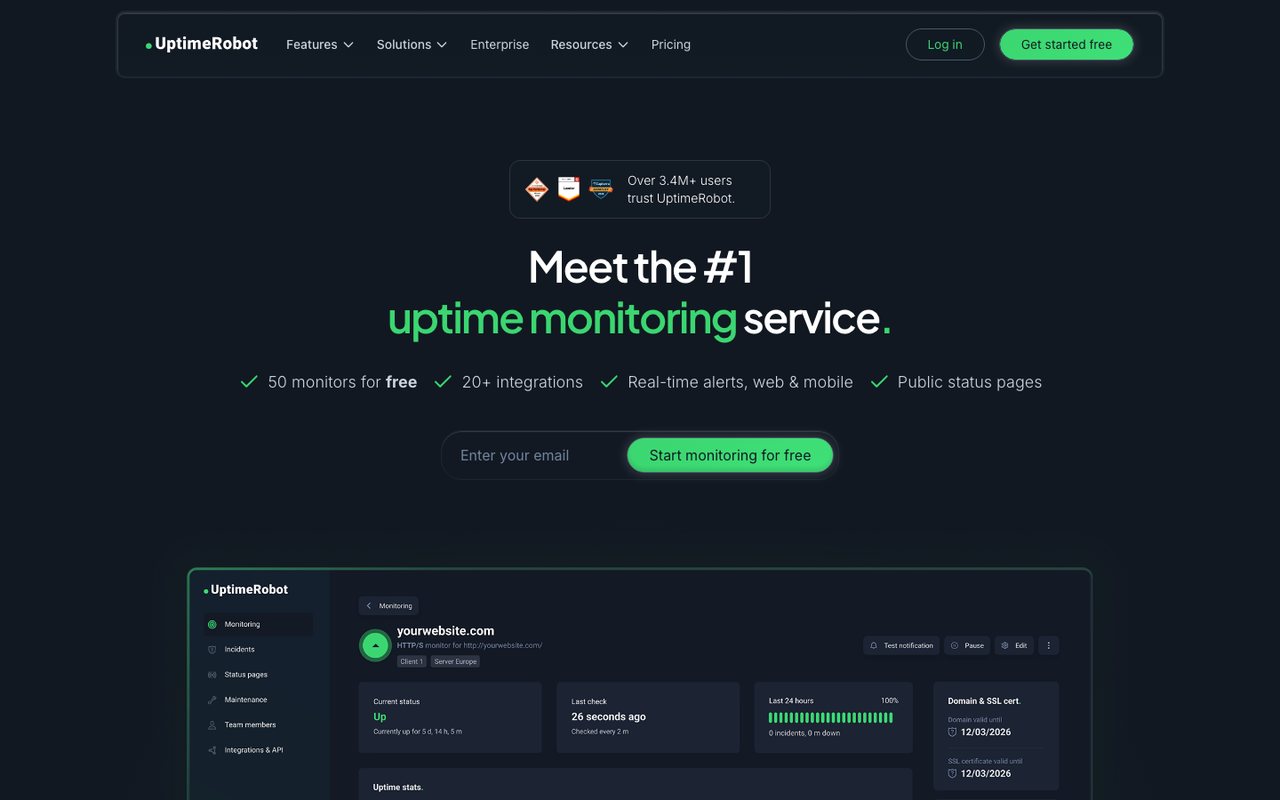
- What it is
- Uptime monitoring for websites, APIs, cron jobs and domains, with status pages.
- Check types
- Website (HTTP), Keyword, Ping, Port, Cron jobs (heartbeat), API, UDP, DNS, SSL certificate, Domain expiry, Third-party dependencies, Status pages
- Free plan
- 50 monitors, checks every 5 minutes
- Paid plans from
- €9 a month, billed yearly
- Fastest check
- 15 seconds
- Prices checked
- 8–12 Oct 2026
UptimeRobot checks websites and servers and alerts you when one stops responding.
Main features:
- Cron Job Monitoring: Alerts you when a cron job fails.
- Port and Ping Checks: Confirms that server services and network devices respond.
- Keyword Monitoring: Checks whether a keyword appears on a page, or has disappeared from it.
- Expiry Alerts: Warns you before SSL certificates and domains need renewing.
- Integrations: A broad set of incident management integrations.
Best suited for:
Anyone from hobbyists to enterprises who wants low-cost monitoring.
Why is UptimeRobot better than Uptime.com?
- It checks as often as every 15 seconds on Scale. Uptime.com's price list stops at 1-minute checks.
- It has a free plan for basic monitoring or for testing the service before you pay.
How is UptimeRobot worse than Uptime.com?
- It has no transaction, page-speed, real user, blacklist or malware monitoring, all of which Uptime.com offers.
- Its free plan checks from one region and runs no SSL or DNS checks.
- Solo plans have one login, where every Uptime.com tier has unlimited users.